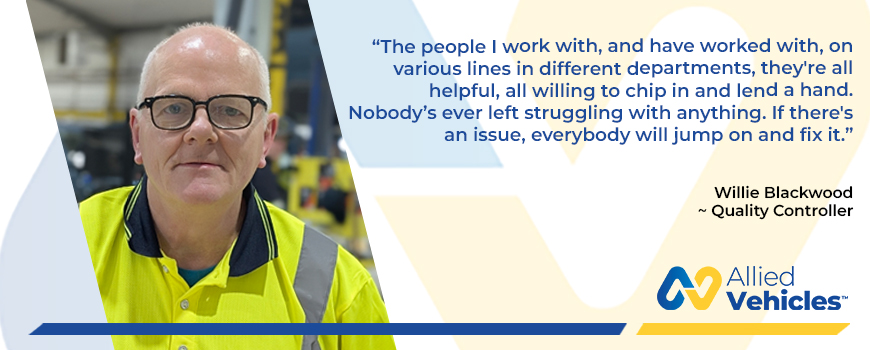
William “Wullie” Blackwood is a Quality Controller on the production line here at Allied, and ensures our wheelchair accessible vehicles are in top condition before they’re shipped out to our customers. With 15 years’ service under his belt he’s seen a lot of changes in the business, so we sat down for a chat about how things have changed, his role in those changes, and how he likes to spend his free time.
What does a Quality Controller do at Allied?
Our job comes at the end of the production line, almost like snagging. We highlight any issues, they’ll be fixed, then the car is out the door to the customer.
So, we make sure that the car’s built to the customer spec, and make sure it has no faults in it. If there are any faults, we would record them and get them fixed before we deliver to the customer.
How long have you worked at Allied?
Just over 15 years, but I’ve been in manufacturing most of my life. I was in Rolls Royce for about 10 years as a Material Controller, then I was in the oil industry as a Friction Welder.
I was, at that point, the only friction welder in the UK for the oil industry. And we trained, maybe, another two people up. Then from there I went to Cummins Diesel Engines as a supervisor in their machine shop – I left there 15 years ago, and I’ve been here ever since.
Briefly explain what friction welding is, for anyone who’s unaware.
So, basically, you’ve got two lengths of pipe, and they’ve got a male to female connection point. Your pipes will get clamped together and will go in a chuck. As it spins, the RPMs increase, and the friction and the pressure create the weld. It’s just friction that welds it together. No torch, no other material involved.
 You must have seen a lot of change in the business over 15 years.
Oh, lots of changes. When I first started, we did a car from start to finish ourselves. So, you stripped the interior and underside, cut it, and rebuilt it. Depending on what car type it was, the shortest was probably about a 13 or 14-hour cycle time up to maybe an Independence which was in the region of about, 40-ish hours to build one.
Over the years we’ve changed to the line format, and there’s a car coming off the line every 90 minutes to three hours, give or take, depending on the model.
How does Allied now compare as a place to work, versus what it was like 15 years ago?
Very different, but in a good way. When I started, we were still a young company; off the top of my head, Production was maybe around 40 people. I think now we’re at 130 or so.
We’ve worked with management to improve a lot of the conditions since then as well, and what we have now compared to how we started, we’ve gone from strength to strength.
How involved have you been in bringing in those changes?
I’ve played a part, I think. We have a comms meeting where we can raise issues and feed back to the managers and directors, and I’ve been part of that for nine years. The guys on the floor raise issues with me, and I raise them at comms.
I’m a great believer in taking up a role where you can make a difference, and through the comms meeting we’re able to do that. We’re communicating stuff to the directors, taking things to a higher level and improving terms, conditions, fixing issues – we’re making the place better.
I’d say every improvement in conditions that we’ve had, has started out on the table at a comms meeting.
You’re obviously quite passionate about it, is that something you would encourage others to get involved in?
Yes. A hundred percent. Don’t get me wrong, you do get people moaning at you sometimes, and with so many people in Production that can be a lot, but you just need to remind yourself you’re making the place better.
What is it about Allied that’s kept you coming back for 15 years?
That’s easy – it’s the people; the people I work with and have worked with on various lines, in different departments. They’re all helpful, all willing to chip in and lend a hand.
Nobody’s ever left struggling with anything, if there’s an issue, everybody will jump on and fix it.
And I’ve had so much support from Allied. Anything I’ve done charity wise, when I’ve been raising money for good causes, they’ve matched it. And with my disability (I’ve had a hip replaced, and I’m waiting to get the other one done) they were great; my manager, the HR department, the Facennas, everybody was so supportive.
 Tell us a bit about the charity stuff you do here.
We’ve not had one for a while, but I used to organise an Old vs Young charity football match. I’m sure we’ll do that again at some point.
Production has a Christmas raffle every year as well. The first time we did it we raised £400, but over the years it’s grown, and we raised £1,400 last year. It goes to whatever charity is in need, really. Last year it went to East Park School in Maryhill.
How do you like to unwind?
I like watching the football and boxing, and my main hobby is fishing.
My son-in-law fishes as well, and we go to areas around Airdrie. I once held the record on the Lily, in Airdrie, for the biggest trout caught in there. I got my photo taken for Sunday Mail for Fish of the Week. Think it was about 14lbs.
I took the boys in the shop floor on a fishing trip a few years ago. The company paid for our permits and put on the bus for us. They keep asking me, “when are you doing another one?”
I might organise that in the new year with the new fishing season
What’s something that not many people here would know about you?
We’re a close bunch so I think they probably know everything. Well, not many would know that I was an undefeated boxer when I was in the army.
When were you in the army?
It was 1979. I was 18, and I was in for three years in The Royal Highland Fusiliers.
I enjoyed that. I took part in a lot of sports; they put me on the football team, the boxing team, running team. If you’re good at sport, it’s one of the places to be.
I was the British Forces Light Weight Boxing Champion. I won about 27 fights all inside the distance. I got asked to go professional when I was already 32, with another boxer from Possilpark, but I thought I was too old.
If you hadn’t ended up in manufacturing, do you think you’d have had a career in sport?
Possibly. When I was younger I was good at football, and I played for a couple of teams. I had some big trials, although didn’t quite make it. And my dad was a Scottish Amateur Boxing Champion, so he taught me since I was a wee boy, and I was always interested in boxing.
But you had to make a choice, because the football teams didn’t let you box at the same time, and the boxing wouldn’t let you play football in case you got injured.
So, you had to pick one, and I probably picked the wrong one. I’ve always wondered though; sometimes I look back, and I wonder how far I’d have gone.