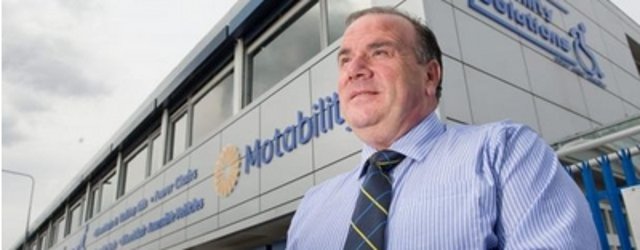
Allied Vehicles co-chairman Gerry Facenna is leading a new initiative to help prevent deaths from heart attacks across Scotland.
The initiative, dubbed CardioCab, involves a partnership between taxi companies and ambulance services to install defibrillator machines in taxis to help reach emergency heart attack cases. The idea has already won support from Glasgow Taxis and Facenna is seeking backing from the Scottish Government and Scottish Ambulance Service.
CardioCab™
The life-saving idea first arose when taxi and wheelchair accessible vehicle manufacturerFacenna attended a training session with the Scottish Ambulance Service, arranged when Allied installed several heart defibrillators (AEDs) at their main plant in Glasgow. The idea also grew out of a family tragedy, when ex-marine Craig Hodgkinson, a close friend of his nephew, died suddenly from an undiagnosed heart condition on the rugby pitch the night before his 28th birthday, in 2007.
Gerry Facenna recalls: “After Craig’s death, our family became closely interested in defibrillator technology and felt strongly about getting the machines installed in more places.
“We decided to have a number of defibrillators installed on-site in Possilpark and to train staff to use them.
“It was during this training session from the Scottish Ambulance Service that I first heard the fact that an ambulance takes an average of 10 minutes to reach a patient in Glasgow. As ataxi manufacturer, I know that research from Glasgow Taxis shows that taxis in Glasgow can reach a customer in three to four minutes – three times faster than the average ambulance response time in the city.
“It suddenly hit me that we could do something amazing to help improve the statistic that only one in 100 people who suffer a heart attack outside of hospital will survive.”
Allied Vehicles is currently in discussion with the Scottish Ambulance Service and the Scottish Government to implement the concept, first in Glasgow, then across Scotland. Allied is also keen to seek UK Government support and ultimately to roll the scheme out across Britain and further afield. Facenna believes there is also potential to seek private sector sponsorship opportunities.
Taxi Training
The initiative will involve giving taxi drivers specialist training to operate the machines. Participation will be optional for cab drivers, although Glasgow Taxis – which operates 900 hackney taxis across the city – is enthusastic about the potential to enlist driver support.
Now Facenna is hoping that funding will be allocated from the Scottish Government to make the concept a reality, sating: “Even the smallest communities in Scotland have taxi services while ambulances, especially in more remote areas, can take up to an hour to reach people. The CardioCab™ scheme could become a lifeline to rural communities. It’s also a chance for our company to give something back to Scotland.”
Facenna adds: “Coronary heart disease costs the NHS more than £3 billion a year and heart disease is some 25% higher in Scotland than the rest of the UK. It’s a big problem and we’re keen to do our bit to help reduce the number of people who die as a result of heart disease; 8,000 people, more than any other disease, died in Scotland in 2010.”
The Craig Hodgkinson Trust, set up by Craig’s parents to raise funds in his memory to donate defibrillator machines to sports teams, clubs and communities, has so far been able to purchase 60 defibrillators.