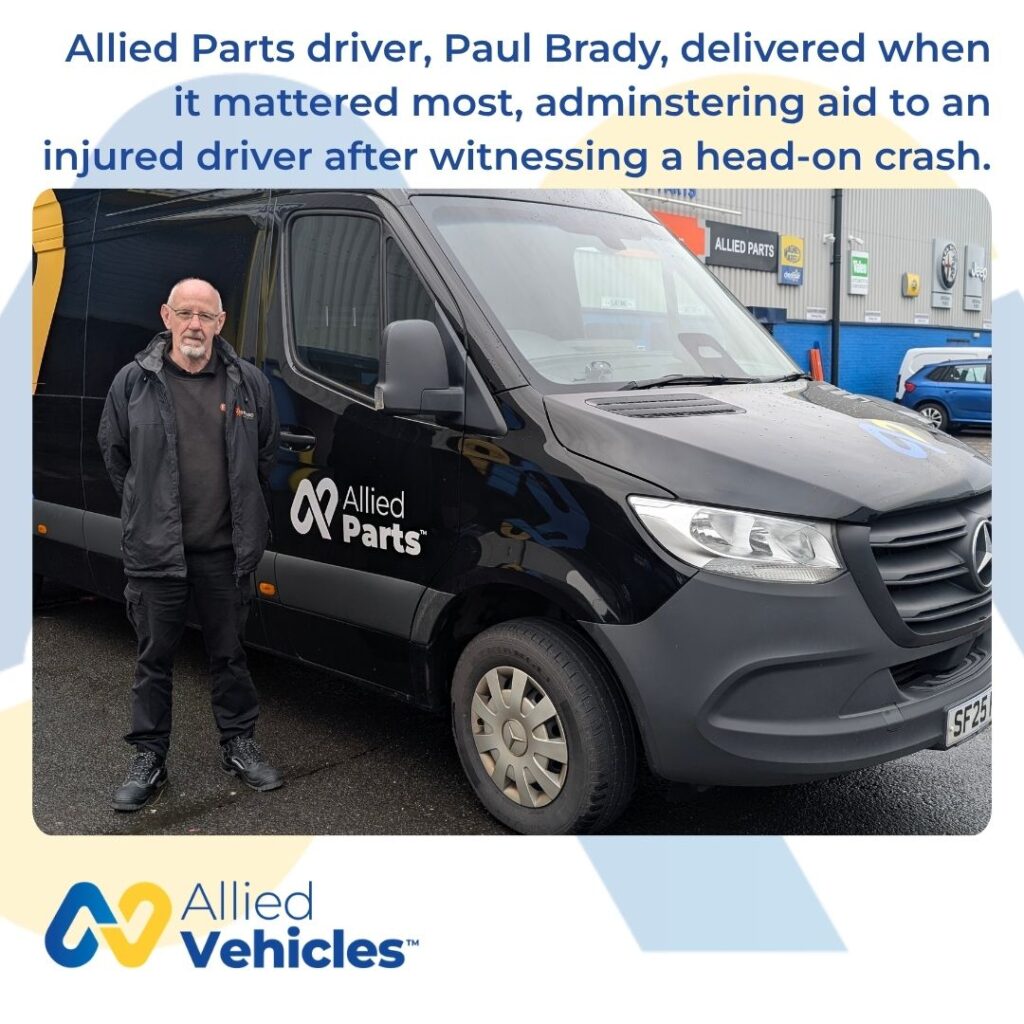
It was supposed to be another just routine day on the road for Allied Parts driver, Paul Brady.
He was travelling on the A9, near the entrance to The Kelpies, when he rounded a long left-hand bend and suddenly saw debris flying from two cars ahead of him.
The vehicles had collided head-on.
“There were headlights and all manner of plastic bits shooting everywhere,” Paul recalled.
The larger of the cars had spun around, settling at a 45-degree angle and was blocking the carriageway. The smaller vehicle involved in the collision had been shunted backwards by the impact.
Paul pulled his Allied van tight to the kerb and got out to help.
“Both of them were significantly damaged, and all the crumple zones had gone,” Paul said. “Fluids were escaping from both cars. Not fuel, thankfully, but the coolants, oils and all the rest of it were leaking everywhere.”
A lorry driver behind him also stopped and the pair approached the larger vehicle, where they found that the driver’s door had been badly damaged and would only partially open.
“Between the two of us we managed to yank the door open and then I started to check on the woman inside,” Paul said.
“She looked in a bad way. Her head was drooped to the side, and her pallor was totally washed out.”
For many people, it would have been an overwhelming situation. But before becoming a driver, Paul had a long career in nursing with the NHS. Faced with an injured and initially unresponsive driver, Paul knew exactly what to do.
Reassuring
“I rubbed on her sternum, which causes a pain reflex,” Paul explained, “she reacted to that and partially rallied, but as soon as she did, she started having a seizure, which I helped to control.”
As the driver started to come around from the seizure, Paul spoke to her, asking her name and whether she was in pain while reassuring her about what had happened.
She told him that her right hip was painful and repeatedly asked to get out of the car, but Paul knew it was safer for her to remain where she was.
“I was just reassuring the woman all the time,” he said. “She kept wanting to get out of the car, but I had to say to her that she was safe and she was best placed where she was, because if her hip pain was due to a break or a fracture then she could do more damage trying to get out of the car.”
Her seatbelt had tightened across her chest and abdomen in the collision and was affecting her breathing, so Paul loosened it. He also checked for obvious injuries and bleeding.
Meanwhile, the car’s automatic accident-detection system had activated, and a voice came through asking about the collision. Paul was able to provide the location and details of the woman’s condition, while answering questions about the scene and whether any fuel was leaking.
As emergency crews made their way to the crash, Paul remained with the woman, keeping her calm and talking to her. Her husband’s number was found among her emergency contact details, and Paul stayed with her until a paramedic arrived and was able to assess her.
The driver of the other vehicle wasn’t complaining of pain, but she was trapped inside her car.
“Later on, she was supported by the critical incident team, and an air ambulance arrived for her as well,” Paul said, “Although she wasn’t reporting pain her injuries must have been serious because they took her away on one of the boards to get her to the hospital.”
By then, the scene was filled with emergency vehicles.
“It all happened in a kind of blur, really,” Paul said.
35 years of experience
Paul is typically modest about his part in what happened.
“I don’t think it was anything spectacular – I think anybody would’ve done the same thing, it was just that I was first on the scene,” he said.
But his 35-year nursing career meant he was able to do considerably more than simply stop and call 999, which would be extent of most people’s ability to help.
Checking the woman’s breathing, helping with the seizure, looking for serious bleeding and assessing her condition were instincts developed over decades of service in the NHS.
“I think the only significant issue, that my background might have assisted in, was the fact that she had lost consciousness and that I was able to rouse her and deal with the seizure and things like that.”
For Paul, those skills have never really gone away.
“It’s just second nature to me now; you don’t lose these things when they’re embedded in you at fairly young age. You hold onto them.”
The lorry driver who had helped him force open the damaged door apparently reached much the same conclusion. Once they had gained access to the vehicle, he told Paul: “I’ll just leave it to you. You seem to know what you’re doing.”
All in a day’s work
Eventually, with paramedics and other emergency personnel caring for the casualties, Paul was told to return to his van.
There was just one problem: he wasn’t going anywhere.

Fire engines, police vehicles and ambulances had left the Allied van boxed in. The interruption ultimately lasted around 90 minutes. Paul called the office to explain what had happened and even sent photographs showing just how thoroughly surrounded he was.
With little else he could do, Paul settled down to wait and opened his lunch.
“I got a cracking view of the helicopter coming in to land while I ate my sandwich.”
Once he was finally able to move the van, the road ahead remained closed while fluids and debris from the collision were cleared, forcing him to turn around and head back the way he had come before returning to his work.
It wasn’t even the last motoring drama of the day. Later, Paul found himself unable to leave the motorway because a car was on fire on the slip road.
“I said to myself, ‘I’m staying away from this place. It’s cursed!’”
Paul has been driving for Allied for just under a year, having previously spent nine years driving for Evans Halshaw after retiring from the NHS. He doesn’t yet have a fixed Allied Parts route, instead covering different runs as required, taking him all over Scotland.
His next journey was set to take him all the way to Elgin, a route he last tackled in winter amid darkness, snowbanks and strong crosswinds.
After what happened on his Falkirk run, though, Paul was hoping this particular trip would prove rather quieter.
“Elgin will take me all day, getting there and back,” he said. “It’s actually a lovely drive, especially the further north you go, but I hope it’ll be much less eventful than that Falkirk run was.
“That was a bit of an adventure. I haven’t heard anything more about it, so I hope that means the drivers are both doing ok now.”